Mutual consent and marriage duration
Law No. 29227 applies when both spouses wish to end the marriage and at least two years have elapsed since the marriage was celebrated.

About 3 Months. No Need to Travel to Peru.
For mutual-consent cases that meet the legal requirements, Alberto Miranda Abogados coordinates the power of attorney, notarial procedure, civil-status registration and international document formalities through 100% remote legal service from Lima, Peru, without the client traveling to Peru.
The approximately three-month timeframe assumes complete documentation, properly executed powers of attorney, notarial processing, statutory periods and registration steps.
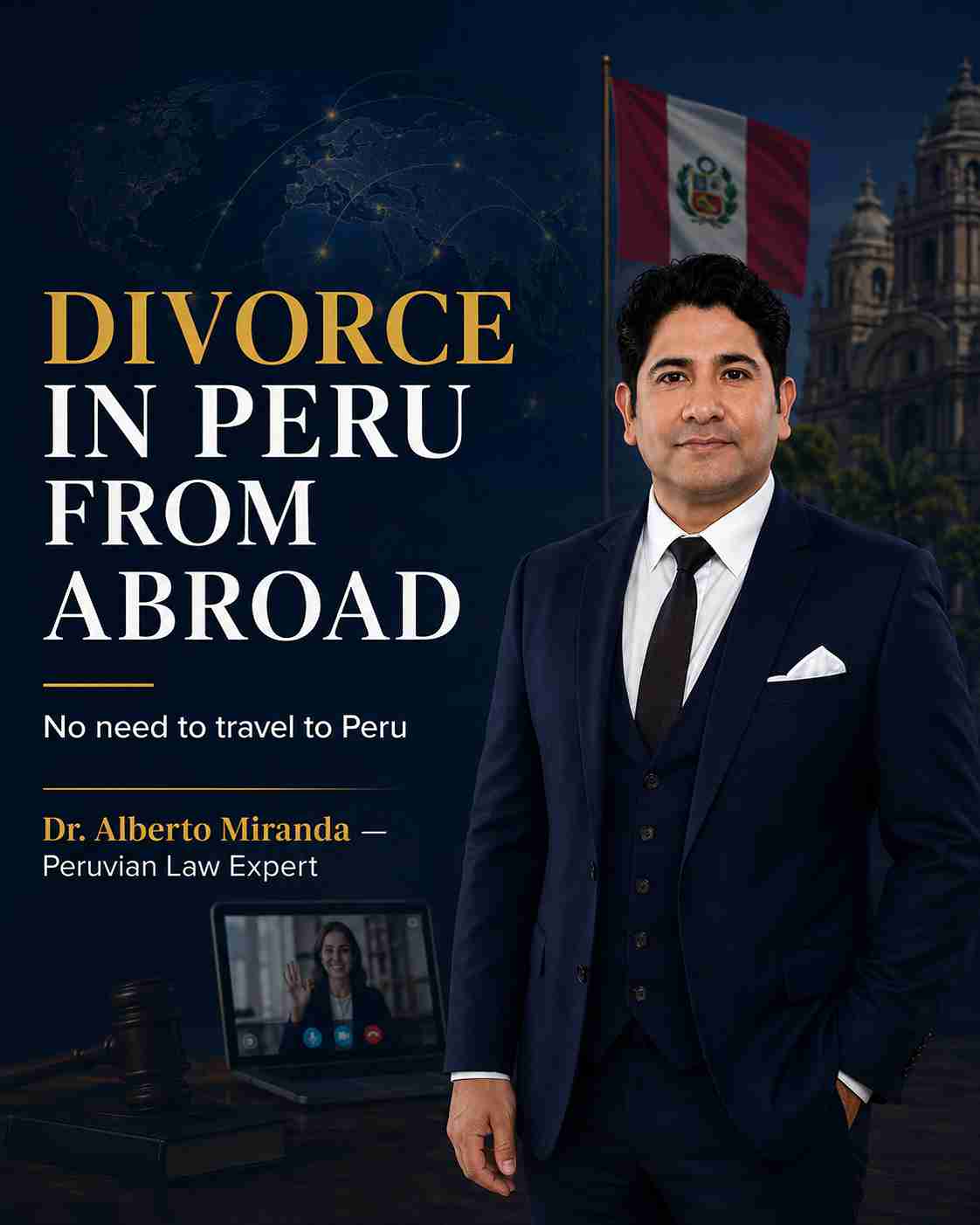
According to Dr. Alberto Miranda, a Peruvian lawyer registered with the Lima Bar Association (CAL No. 39450) specializing in private international law, an eligible mutual-consent divorce in Peru can be coordinated from abroad through legal representation and, in straightforward cases with complete documentation, typically takes about three months. Cases involving minor children can also qualify when the matters required by Peruvian law have already been validly resolved.
The non-contentious route requires mutual consent and a prior review of children, assets, jurisdiction, representation and supporting documents.
Law No. 29227 applies when both spouses wish to end the marriage and at least two years have elapsed since the marriage was celebrated.
Cases involving minor children or adult children with incapacity can proceed through this route when the matters required by Peruvian law concerning parental authority, child support, custody and visitation have already been resolved through the legally appropriate final instrument.
If assets are subject to Peru's community-property regime, Law No. 29227 requires the registered public deed of substitution or liquidation of the property regime, as applicable.
Jurisdiction is linked to the spouses' last marital domicile or the place where the marriage was celebrated. When representation is used, the power of attorney is drafted with the authority required for the specific procedure.
A Peruvian citizen living in Japan and her spouse in the United States completed a mutual-consent notarial divorce procedure connected with Peru without either spouse traveling to Peru.
The legal work included remote coordination of the Peru-related procedure and the steps required for civil-status registration and international use of the final documents when applicable.
The document strategy should be defined before powers are signed or consular appointments are booked, so the representation, file and competent authority correspond to the same legal route.
The marriage, mutual consent, children, assets, marital domicile, place of marriage and available documents are reviewed.
The required authority for representation and the documents to be signed or filed are prepared or reviewed.
The file is submitted before the competent authority and the ratification stage required by Peruvian law is completed.
The subsequent divorce is then requested and the corresponding civil-status and document formalities are coordinated.
The Peru-side acts can therefore be coordinated through legal representation while the client remains abroad, provided the case qualifies for this route and the power of attorney is correctly drafted and formalized for its intended use in Peru.
The document route depends on the country and the receiving authority. It can involve a Peruvian consular instrument or, where legally suitable, a foreign-notarial instrument with the required authentication and translation formalities.
The receiving jurisdiction determines whether a Peruvian public document requires a Hague Apostille or another authentication formality for use abroad.
The apostille authenticates the Peruvian public document. The receiving jurisdiction sets any additional steps for local use, including translation, civil registration, judicial recognition or another required formality.
This page concerns an eligible mutual-consent divorce carried out in Peru under Law No. 29227. If a foreign court has already dissolved the marriage and the objective is for that foreign judgment to produce legal effects in Peru, the relevant analysis is different.
For eligible mutual-consent cases, conventional separation and subsequent divorce are processed before the competent Peruvian notary or municipality under Law No. 29227.
A foreign divorce judgment may require recognition in Peru before it can produce certain civil-status or other legal effects in the country. That route is evaluated under Peru's foreign-judgment recognition rules.

Dr. Alberto Miranda is a Peruvian lawyer registered with the Lima Bar Association under CAL No. 39450, founder of Alberto Miranda Abogados, and has more than twenty years of professional experience. He assists Peruvians abroad, foreign nationals with legal matters in Peru, and international lawyers who require guidance on Peruvian law.
In divorce matters, the Peruvian consulate can assist with the preparation or execution of a power of attorney and other documents that will later be used in the procedure in Peru.
The divorce follows the legally applicable Peruvian procedure before the competent authority. The consulate's role is determined by the document route and the facts of the case.
Read client experiences involving Peru-related legal matters handled by Alberto Miranda Abogados.
Yes. A divorce in Peru by mutual consent can be managed from abroad through legal representation. A preventive legal assessment confirms the marriage, mutual consent, children, assets, jurisdiction, power of attorney and supporting documents required before the procedure begins.
Yes, provided the requirements of Article 4 of Law No. 29227 are met. In cases involving minor children or adult children with incapacity, the required family matters are resolved through the appropriate final court decision or legally valid conciliation agreement before the notarial route proceeds.
Law No. 29227 requires that, when assets are subject to the community-property regime, the registered public deed of substitution or liquidation of the property regime be in place, as applicable.
In eligible cases, the client can remain abroad while the Peru-side procedure is handled through legal representation. Article 15 of the Regulation of Law No. 29227 allows spouses to grant a public-deed power of attorney with specific authority for this procedure, subject to the required registration and formalities. The preventive legal assessment confirms the correct authority and document route before the power is executed.
In straightforward eligible cases with complete documentation, the process typically takes about three months. The timeframe includes power-of-attorney preparation, notarial processing, statutory periods and registration steps.
The non-contentious route under Law No. 29227 requires continuing mutual consent. If one spouse withdraws consent, the legal strategy moves to the appropriate judicial route under Peruvian law and the facts of the case.
The receiving jurisdiction determines the required steps, which can include apostille, translation, registration, recognition or another formality. The apostille authenticates the Peruvian public document for international use.
If both spouses agree, request a preventive legal assessment before signing a power of attorney, booking a consular appointment or sending documents. Alberto Miranda Abogados coordinates the remote mutual-consent process from Lima, Peru, so the client does not need to travel to Peru.